

Too many manufacturability issues—like severe mold warping or sink marks—are caught too late. Discovering these flaws during expensive mold simulation analysis, or worse, after the tool is already being cut, is a massive drain on your engineering resources.
Why wait for a downstream bottleneck to uncover design risks you could have prevented on day one?
The True Cost of the Status Quo
When designers rely on downstream mold-flow analysis or the tooling manufacturer to catch sink marks and warpage, the company pays a steep price in three areas:
- Wasted Money (Cost of Change): Modifying a physical mold because of a late-stage warpage discovery costs thousands—sometimes tens of thousands—of dollars. Even in the virtual phase, running heavy mold-flow simulations on unoptimized designs wastes expensive software compute time and analyst hours.
- Wasted Time (Bottlenecks): Simulation specialists and tooling engineers are often backlogged. Waiting days or weeks for them to return a report that says, “This rib is too thick and will cause a sink mark,” stalls the entire project.
- Lost Revenue (Delayed Launches): Every design iteration and engineering change order (ECO) pushes the product launch further back, giving competitors an edge and delaying your time to revenue.
From “Oops!” to Early Risk Detection
DFMPro shifts manufacturability validation from a costly “find problems later” approach to an efficient “prevent problems earlier” approach.
| Phase | Before DFMPro (The Status Quo Approach) | After DFMPro (The Shift-Left Approach) |
|---|---|---|
| 1. Design | Designer finishes the CAD model without immediate manufacturing feedback. | Designer works in CAD and runs DFMPro natively within the design environment. |
| 2.Validation | Design is “thrown over the wall” to a CAE analyst or tooling engineer. | DFMPro instantly highlights areas prone to sink marks or warping. |
| 3.Correction | Designer waits days for the analysis report, then has to re-open the file and figure out how to fix it. | Designer fixes the geometry on the spot while the design is still fresh in their mind. |
| 4.Handoff | High risk of the design bouncing back and forth multiple times between departments. | A clean, highly optimized design is sent for final mold analysis, usually passing on the first try. |
The Bigger Picture
For injection-molded components, sink marks and warping are incredibly common but highly preventable design risks. DFMPro integrates directly into your CAD workflow, analyzing plastic components and highlighting problematic areas based on configurable manufacturing guidelines and conditions.
It empowers engineers to ask—and answer—the most important question instantly: “Is this design likely to create a molding problem?”
Detailed mold-flow analysis is incredibly valuable, but it should be used for deep process validation, not for catching basic geometry mistakes. Let DFMPro act as your early screening layer so your specialists can focus on complex problems, not correcting wall thickness ratios.
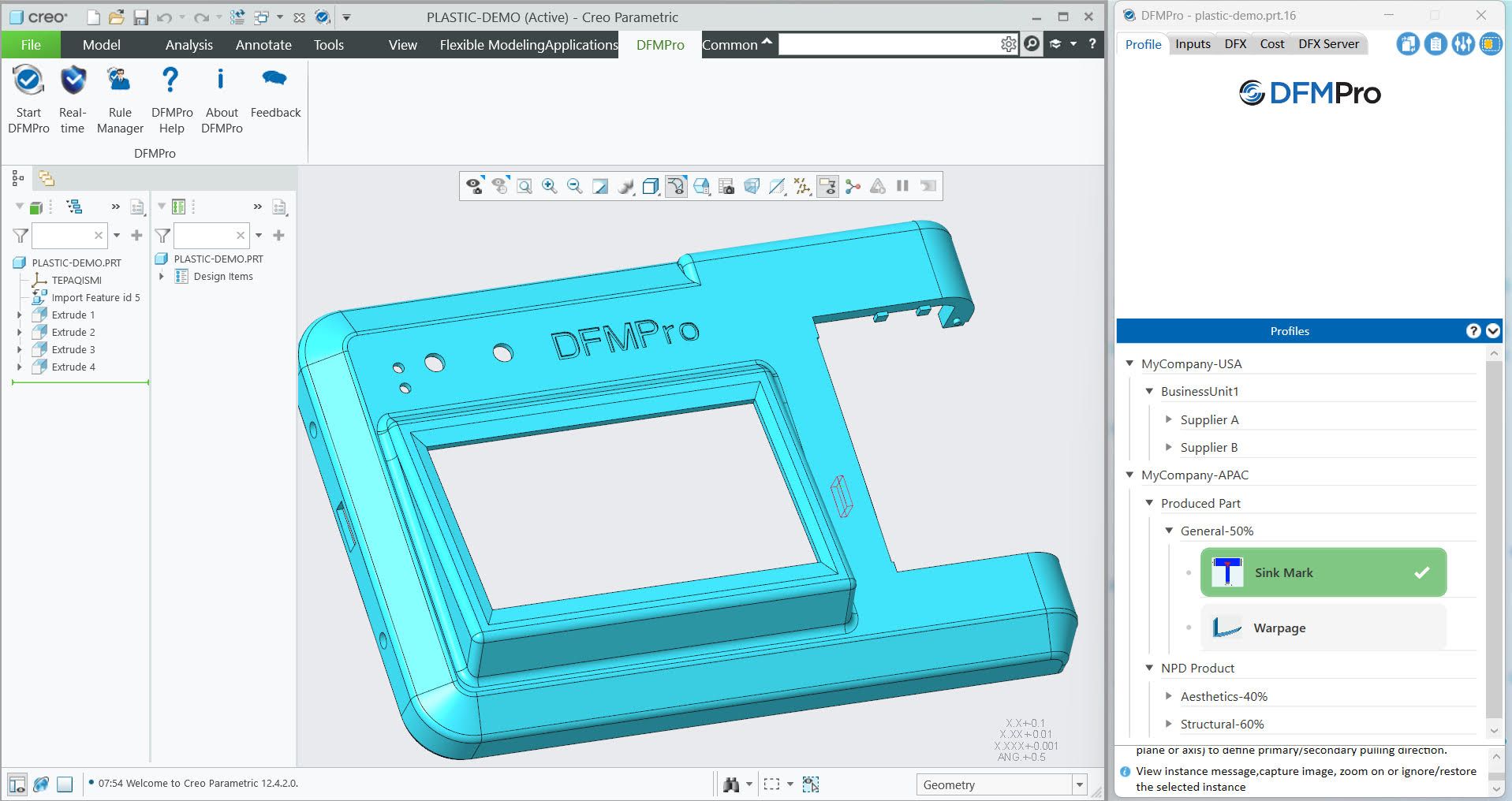
Key Benefits
- Early Risk Identification – Detect potential Sink Mark and Warpage issues earlier during CAD design.
- Reduce Mold Iterations – Address design-related risks before downstream tooling development.
- Faster Design Reviews – Automated checks provide immediate feedback to designers.
- Design Right First Time – Improve manufacturability before releasing the design for tooling.
- Reduce Engineering Rework – Minimize late-stage design changes and tooling modifications.
- Standardize DFM Practices – Apply company-specific molding guidelines consistently across engineering teams.
- Accelerate Time-to-Market – Reduce the dependency on lengthy downstream validation cycles.
- Complement Mold Analysis – Use DFMPro as an early screening and prevention layer, while detailed mold-flow analysis can be used later for deeper process validation.
Design it right. Validate it early. Manufacture it with confidence—with DFMPro.