


The mechanical engineering world is riding an AI wave. The narrative increasingly favors “probabilistic” systems— that learn from historical data and tribal knowledge to predict manufacturing friction. However, for the engineer on the shop floor or the lead designer facing a hard deadline, a critical truth remains: AI is a powerful engine, but rules-based systems are the tracks it runs on.

To build resilient, high-velocity digital engineering workflows, we must move past the false dichotomy of “Rules vs. AI.” Deterministic rules remain indispensable; AI’s most valuable role is to augment them—making rules faster, more contextual, and more adaptive without sacrificing the guarantees that physics, geometry, and safety demand.
- The Physics of “Truth”: Why Rules Cannot Be Replaced
AI excels at pattern recognition. Mechanical engineering is governed by inviolable laws of physics and geometry. This creates a divide between deterministic computability and probabilistic inference:
- Safety Mandate (Pass/Fail Logic): In aerospace, medical devices, automotive safety systems, pressure vessels, and critical tooling, “probably manufacturable” is not acceptable. Rules encode hard constraints: minimum wall thickness, draft angle bounds, bend radii, corner fillets, tool accessibility, and GD&T requirements. If a pressure vessel’s hoop stress calculation exceeds allowable stress, or if thickness derived from design pressure , radius , material strength and safety factor is below code minimums, rules flag the design every single time. Probabilistic models can miss outliers, conflate context, or produce spurious correlations when data distributions shift.
- Checking Standards: While AI excels at optimizing complex patterns, mechanical engineering requires absolute adherence to Standardization Integrity. For critical parameters such as drill sizes, fastener diameters, and thread sizes, the system must utilize deterministic hard checks rather than probabilistic models. In standard hardware selection, “close enough” is a failure state. Probabilistic AI approaches may attempt to interpolate between discrete standard sizes, leading to the specification of non-standard or non-existent tooling and fasteners.
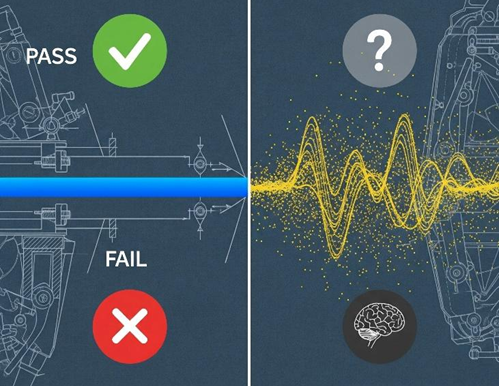
- The Cold Start Problem: AI needs representative, labeled, high-quality data. When shifting to a new material system (e.g., aluminum to high-performance composites), a new process (e.g., L-PBF metal AM vs. subtractive), or a new supplier ecosystem, there is no historical baseline for AI to learn from. Rules, by contrast, work on Day 1 because they derive from first principles (mechanics, thermodynamics, material science) and validated process capability—not past data.
- Determinism Yields Explainability: Engineering auditability and regulatory compliance (e.g., requirements traceability for standards and quality systems) favor rules. Deterministic checks yield clear artifacts: which rule triggered, why it triggered, and what change resolves the issue. This traceable causal chain is essential in safety-critical environments and for certification workflows.
- The Great Filter: AI as the “Noise Reducer” for Rules
Rules-based DFM can produce alert fatigue: warnings that are technically valid but contextually inconsequential. This occurs when trade-offs are acceptable within a narrowly defined process window or supplier capability that the base rule didn’t encode.
AI’s first augmentation role is “Intelligent Violation Filtering”:
- Learn From Historical Waivers: Over time, engineers waive certain alerts (e.g., a machining feature that violates a global L/D ratio but is acceptable for a supplier with long-reach tooling). An AI layer can learn from waiver frequency, reasons, and outcomes to automatically suppress repeat false-positive alerts.
- Contextual Reweighting: AI can score violations by risk using signals like feature criticality, downstream operation sensitivity (e.g., heat treat, welding, post-machining), cumulative tolerance stack-ups, and supplier process capability (Cp/Cpk). Alerts with lower inferred risk or high historical waiver rates are de-prioritized, while high-risk alerts surface prominently.
- Human-in-the-Loop Governance: Even when AI proposes suppressions, rules retain primacy. Violations are never auto-approved; they are ranked and available for expert review. Design Engineers see fewer, higher-fidelity alerts, accelerating decision-making without hiding true must-fix defects.
Practical tip: If you use DFMPro, leverage auto-ignore functionality that learns from organizational actions—those of the community or expert reviewers—to reduce noise while preserving rigor.
- From Static to Dynamic: AI-Augmented Process Knowledge
“Tribal knowledge” is one of the most undervalued assets in manufacturing organizations. Capturing it as living, executable logic is where AI materially improves rules management.
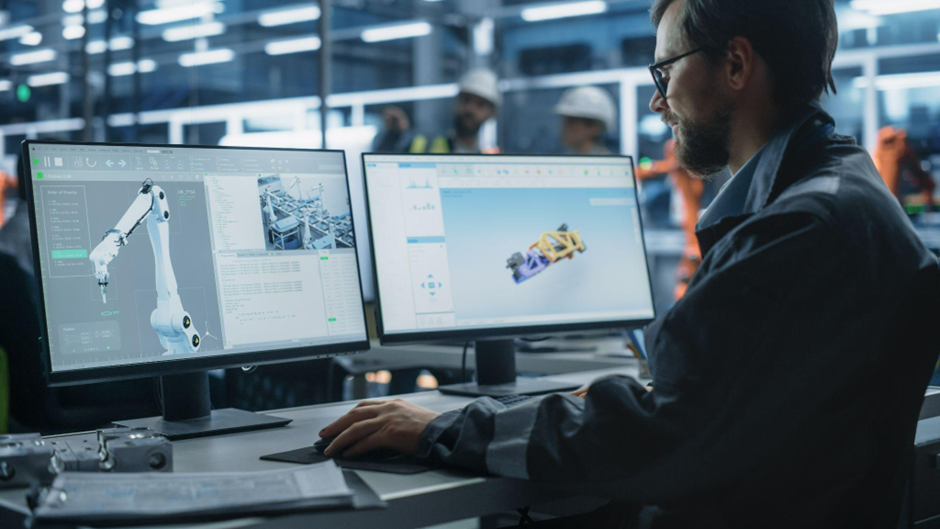
- Automated Rule Discovery: Traditionally, updating a ruleset required experts to codify new constraints (e.g., “min corner radius when using tool X on alloy Y is Z”). AI can mine ECOs, NCRs (non-conformance reports), supplier corrective actions, inspection reports, and “return to vendor” tags to propose candidate rules:
- Example: “30% of parts with flange height < h were rejected by Vendor X due to vibration in finishing ops. Suggest raising min flange height by 2 mm for this supplier.”
- AI doesn’t enforce the new rule; it proposes it with evidence (frequency, severity, cost impact) so domain experts can verify and ratify.
- Supplier-Specific Tuning: Different facilities have distinct machine envelopes, fixturing libraries, cutting tool inventories, heat dissipation characteristics, and inspection methods. AI can adjust parameterized rules (e.g., max pocket depth, min hole diameter for a given L/D, allowable surface finish given toolpath strategy) per selected supplier. The core rule remains; AI specializes in the execution context.
- Rule Drift Monitoring: Just as models drift, so can rules become stale. AI can monitor exceptions, yield loss, and cycle time deltas to flag rules that underfit or overfit the operating reality—prompting a review. Data captured using the DFX Analytics module of DFMPro can help predict such drifts and identify corrective actions.
- Process-Specific Realities: Rules vs. Learning
Manufacturing Process | The Rules-Based Bedrock | The AI Augmentation |
Injection Molding | Hard limits on draft angles and uniform wall thickness to ensure part ejection. | AI may be able to predict complex cooling-induced warpage that simple geometry rules cannot see. |
Sheet Metal | K-factors and minimum bend radii based on material physics. | AI can analyze “tribal” nesting patterns to minimize scrap material based on current sheet costs. |
CNC Machining | Ensuring tool access and preventing spindle collisions. | AI can potentially optimize tool-pathing sequences to reduce cycle time while the rules ensure zero crashes. |
Generically, AI can learn acceptable design standards based on existing organizational designs which have passed checks and are released to manufacturing.
- The Risk of the “Black Box”

AI’s biggest DFM risk is loss of traceability. If a design change is made because “the pattern suggested it,” and the part fails later, forensic accountability is murky.
- Rules Provide an Audit Trail: Deterministic checks such as those in DFMPro create explainable artifacts—which rule fired, why it fired, which parameter was violated, and what remediation was applied. This is essential for quality system audits, customer PPAP packages, and certification environments.
- AI Must be a “Glass Box” in DFM: Use AI to propose parameter adjustments or rule candidates; require human verification before codification. Maintain model cards, training data lineage, versioning, and override reason codes.
- Standards Alignment: A traceable, rule-centric workflow supports compliance frameworks and internal governance (e.g., ISO-like quality systems, aerospace-grade process control). The auditability advantage of rules is strategic; AI should enhance it, not obscure it.
Conclusion: The Hybrid Engineering Workflow
The future of mechanical engineering isn’t a choice between “Old School Rules” and “New School AI.” The most competitive firms will choose solutions which provide and enable a sandwich architecture:

- The Foundation (Rules): Catching 100% of the “must-haves” and safety-critical constraints.
- The Intelligence Layer (AI): Tailoring those rules to specific suppliers, reducing noise, and surfacing “similar” past failures.
- The Decision Layer (Human): Using the filtered, high-fidelity data from both systems to make the final call.
AI will not replace the rules of engineering. It will finally make those rules smart enough to keep up with the speed of modern design.
Why This Matters: Speed Without Compromise
Purely rules-based systems deliver safety and consistency but can be rigid and noisy. Purely AI systems deliver speed and adaptability but can be opaque and non-deterministic. The hybrid approach:
- Preserves deterministic guarantees for must-haves.
- Adds contextual agility via AI.
- Improves usability by cutting alert fatigue.
- Increases supply chain resilience by aligning rules to real, evolving capabilities.
In short: AI does not replace the rules of engineering. It finally makes those rules smart enough to match modern design velocity—without eroding the bedrock of physics, geometry, and safety.
End note:
Note that rule-based systems can also be classified as a form of Artificial Intelligence (AI) — specifically, they fall under the category of symbolic AI or Good Old-Fashioned AI (GOFAI).
Here’s a breakdown:
✅ What is a rule-based system?
A rule-based system uses explicitly defined rules to make decisions or solve problems. These rules are crafted by human subject matter experts, and the system applies them to the input data to produce outputs.
✅ Why is it considered AI?
- It automates reasoning and decision-making.
- It mimics expert human behavior in narrow domains (e.g., medical diagnosis, design validation, troubleshooting systems).
- It was one of the earliest approaches to AI before the rise of machine learning.
The AI we are referring to in the earlier part of the article is modern AI which learns from data and is probabilistic in nature.